The Russian Federation is the largest country on earth, spanning over seventeen million square kilometres. Its easternmost tip is the Chukchi Peninsula.
Russia's topography includes the world's deepest lake and Europe's highest mountain and longest river.
The broad European Plain, or Volga River Plain extends from the Ural Mountains to its western borders.
In the far southwest the Caucasus Mountains slice across the land. The country's highest point, Mt. Elbrus, is located here, at 5642m.
The central and southern areas include large fertile areas, marsh, steppes and massive coniferous forests.
Siberia is a combination of frozen tundra, with rolling hills rising to plateaus, and numerous rugged mountain ranges.
The northeast, south-central and southeast areas are covered by a wide variety of mountain ranges.
A few on the Kamchatka Peninsula are active volcanoes. Significant rivers of Russia include the Volga, Lena, Ob, and Yenisey.
Lake Baikal is the deepest lake in the world, at 1637 m.
Largest Cities: Moscow, St. Petersburg, Novosibirsk, Sverdlovsk, Rostov, Vladivostok, Irkutsk, Volgograd, Omsk
Russia Physical Map

Physical map of Russia, equirectangular projection
Click on above map to view higher resolution image
Russia physical features
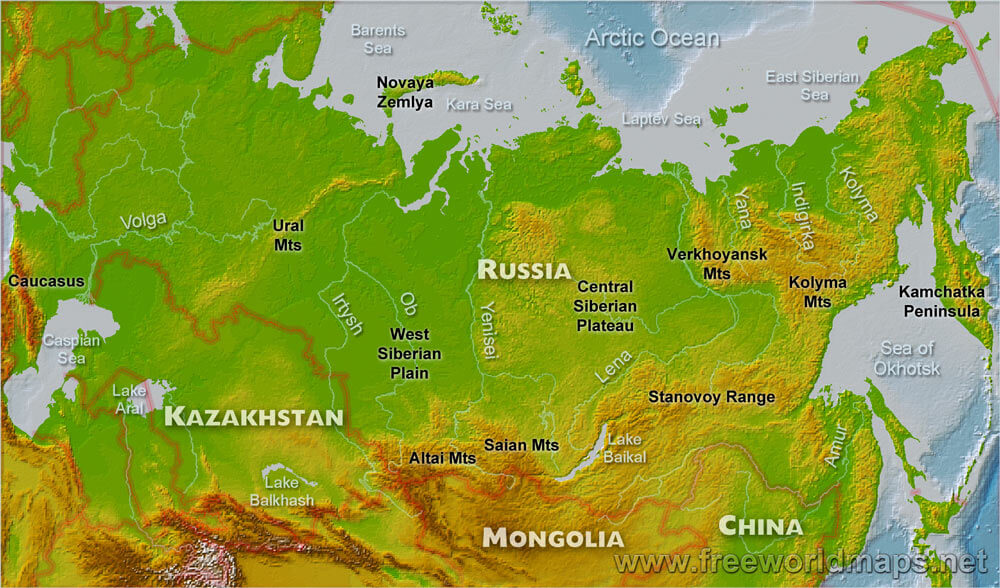
Russia geography
Click on above map to view higher resolution image
Other maps of Russia


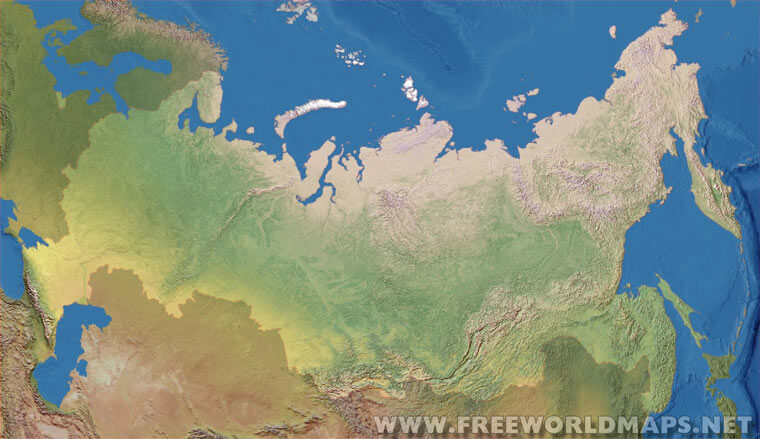
Customized Russia maps
Could not find what you're looking for? Get a unique Russia map!Crop a region, add/remove features, change shape, different projections, adjust colors, even add your locations!